
Lenovo Iberia held the “Think Update” event, a meeting with the media and professionals in which the company presented the latest developments in its professional portfolio and its strategic vision for the future of the digital work environment. During the day, different company officials shared the evolution of the brand towards a comprehensive technological ecosystem driven by artificial intelligence, transversal security and a strong commitment to the sustainability and repairability of devices.
The event has also served to show the latest innovations of the Think family, which continues to be the pillar of Lenovo’s professional business, with emblematic equipment such as the ThinkPad X1 Carbon, the innovative ThinkPad X1 Fold or the powerful ThinkPad X9 Aura Edition.
Product strategy focused on modularity and sustainability
Patricia Núñez Sanz, head of the PC and Smart Devices business at Lenovo Iberia, opened the meeting by explaining how the company is evolving its portfolio to respond to the changing needs of modern work environments.
As highlighted, Lenovo is committed to modular, sustainable and increasingly repairable equipment, a strategy that is being transferred to all product ranges, from corporate devices to consumer devices.
“We are promoting a product strategy designed for the professional environment based on modular, sustainable and repairable concepts,” explained Núñez. “But we are also innovating in the consumer area, where we have taken a step forward with proposals such as 3D screens without glasses or new device formats.”
For the board, Lenovo’s objective is clear: to bring technological innovation closer to users in a practical and accessible way. “All our launches and concept visions seek to put technology within the user’s reach, facilitating new ways of working and interacting with devices,” he added.
Lenovo bets on hybrid AI as a business model
One of the central axes of the event was the role of artificial intelligence in Lenovo’s strategy. Juan José Marcilla, Commercial Product Manager at Lenovo Iberia, explained how the company is evolving towards a model that ranges from the personal device to cloud infrastructure.
“From 2024 we are clearly in the era of artificial intelligence. Lenovo has a unique position because we are a 360º provider that offers complete solutions for partners and companies,” he noted.
In this sense, the company has developed a complete portfolio that covers all levels of the technological ecosystem, including solutions under the ThinkEdge, ThinkAgile and ThinkSystem ranges, as well as innovations in liquid cooling for data centers with Lenovo Neptune technology.
The company’s strategy is based on the concept of Hybrid AI, an approach that allows companies to adopt artificial intelligence by safely combining on-premises and cloud environments. Marcilla also highlighted the growing business interest in so-called agentic AI, which represents a new generation of systems capable of making decisions and executing tasks autonomously.
“Interest has grown by 52% in companies around this technology. Lenovo is prepared for this agentic AI model and we have parameterized and tested solutions in different industries and for different use cases, from improving customer service to agents that help with aspects of employee support,” he stated.
To facilitate this adoption, Lenovo is developing tools such as its AI Library, a library of artificial intelligence solutions ready to be implemented in different sectors.
Qira, Lenovo’s new artificial intelligence super agent
Within this strategy, Qira is positioned as the new artificial intelligence assistant developed by Lenovo to be integrated transversally into its entire ecosystem of devices.
Jorge Hernández, Client Technologist at Lenovo Iberia, explained the central role that this technology plays in the company’s new products.
“At the core of our AI strategy we have Qira, a transversal AI that is found in all our new devices,” he said. “Qira allows you to track tasks between your mobile phone, laptop or wearables, learning from us and becoming a true comprehensive assistant.”
This artificial intelligence is designed to function as a super agent that connects different devices and sources of information, facilitating task management, process automation and improving productivity.
In addition, Lenovo is integrating Qira into various corporate services, such as its Workplace platform, where it can help resolve incidents or improve the employee experience through automated ticketing and support systems.
The company has also developed specialized agents, such as LISSA, aimed at measuring the sustainability impact of technological solutions by analyzing the life cycle of the equipment and planning its renewal.
Innovation in devices and future concepts
During the event, Lenovo also showed several prototypes and concepts that anticipate the evolution of its professional devices. These devices were already shown previously at the CES and MWC 2026 fairs. Among all of them, the ThinkPad Rollable stands out, a laptop with a roll-up screen capable of going from 13 to 16 inches, as well as the ThinkBook Modular AI PC Concept, which introduces a modular architecture designed to adapt to different use needs.
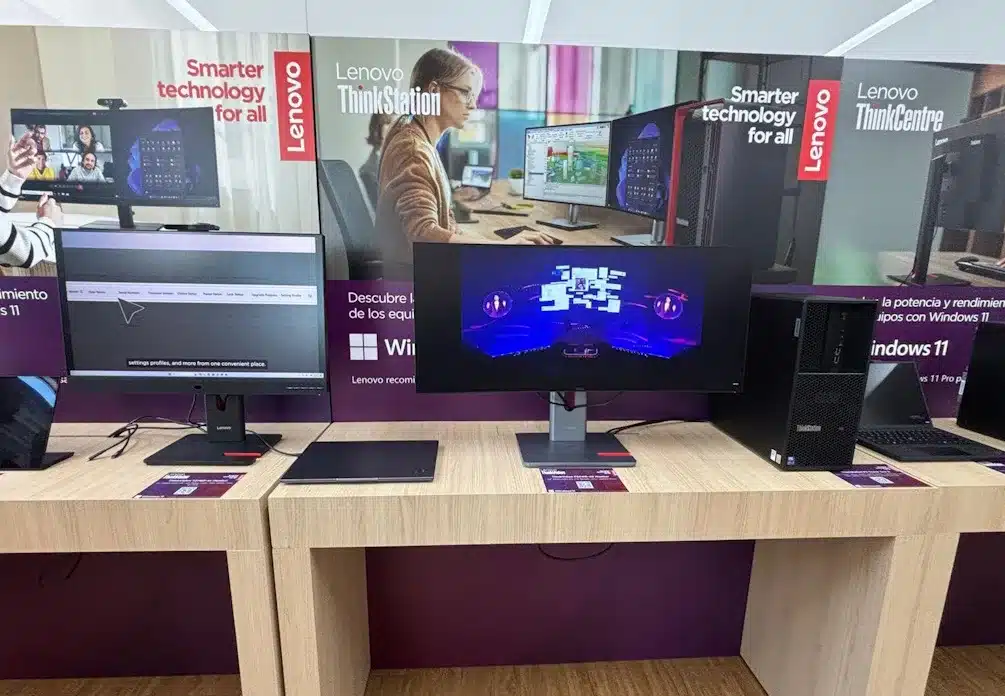
Other concepts presented included the Yoga Book 3D Concept, with glasses-free three-dimensional viewing technology, or the Legion Go Fold, a foldable portable console with different game modes.
In the field of smart accessories, Lenovo also showed the AI Work Companion Concept, a device that combines calendar, clock, task manager and desktop docking station functions.
Repairability and sustainability as pillars of design
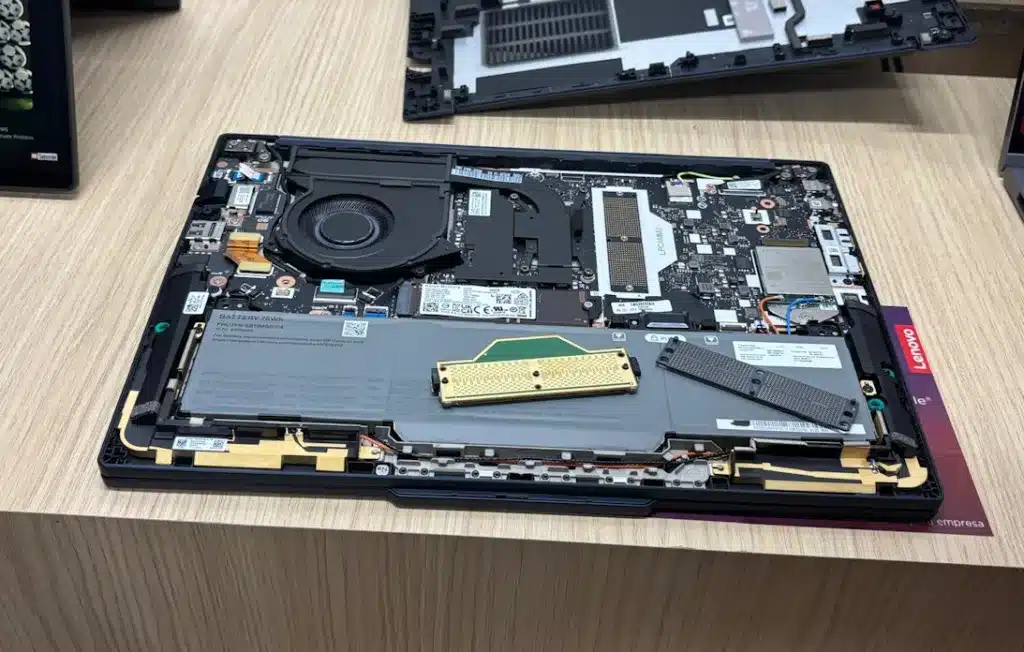
Beyond technological innovation in products, Lenovo wanted to highlight its commitment to sustainability, especially through improving the repairability of its equipment in terms of batteries, USB C ports, fans and heatsinks, as well as memories.
As Hernández explained, some of the company’s new models are reaching very high levels of repair. An example is the ThinkPad T14, which has achieved a score of 10 out of 10 for repairability according to iFixit, allowing components such as the battery or cooling system to be easily replaced.
Lenovo is integrating Qira into different corporate services, such as its Workplace platform, where it helps resolve incidents or improve the employee experience
The company is also incorporating technologies such as LPCAMM2 memories, which allow the creation of lighter and more energy-efficient equipment, with modules that are easy to replace and expand.
ThinkShield: comprehensive security across the entire ecosystem
Security was another of the big topics. Lenovo highlighted the role of ThinkShield, its comprehensive security platform that spans from hardware to software and services. ThinkShield incorporates technologies designed to protect the supply chain, ensure device integrity from the manufacturing process, and reduce the number of system vulnerabilities.
In addition, Lenovo works with various technology partners to strengthen cloud operating system protection and ensure that corporate devices maintain the highest levels of security throughout their lifecycle.
Motorola strengthens the business ecosystem
In Motorola’s mobility area, Miguel Ángel Gómez, Product Manager of Motorola Iberia, explained how the company is strengthening its presence in the business market. As he explained, Motorola is registering strong growth in the premium segment and in the B2B market, especially in sectors such as banking. “We are seeing growth in all regions, with EMEA growing double digits and an increase of more than 42% in the brand’s premium devices,” he noted.
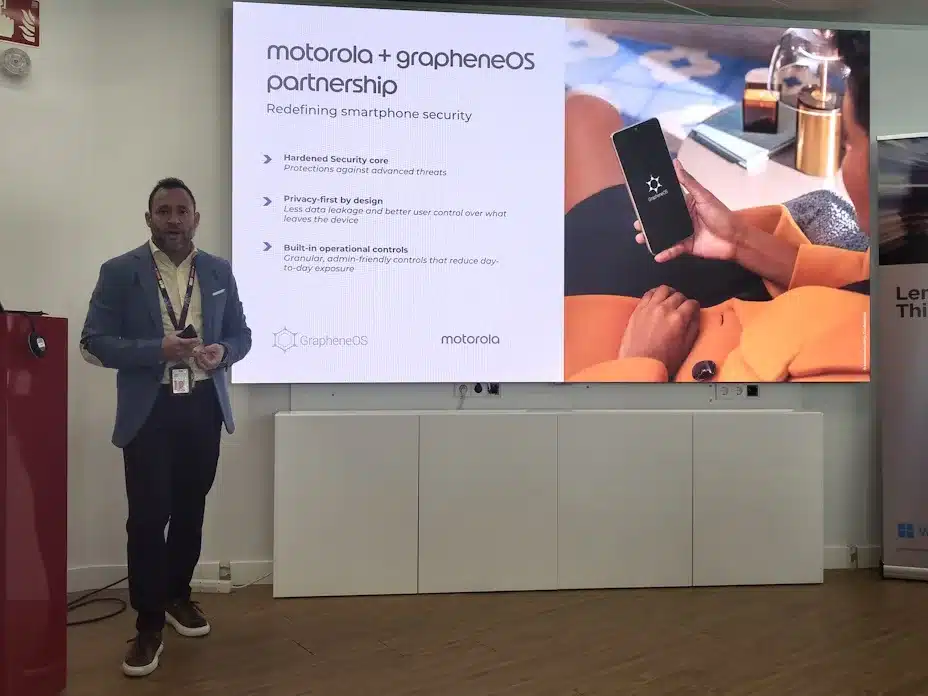
Among the featured solutions are the Business Edition devices, designed for companies, which integrate advanced security functions such as Moto Secure or analytics systems to monitor corporate equipment in real time.
Motorola and Lenovo are improving the user experience between their devices through Smart Connect, the platform that allows you to control different devices from a unified interface. In the future, this platform will also incorporate Qira, which will allow artificial intelligence to be unified throughout the entire ecosystem of devices of both brands.
