
An hour from New York and lost in the middle of a forest. As you drive along the local road, no one could imagine that among the immensity of oaks, maples and birches is one of the main development centers for quantum computing. It is here, near several nature reserves, that IBM has its main research headquarters: the Thomas J. Watson Research Center.
Built under Thomas J. Watson Jr. (son of the Blue Giant’s founder), the company realized it needed to centralize its scientists and researchers. The goal was to create an environment isolated from commercial noise. A “pure research” space had to be developed and to do so it acquired a large piece of land in a natural environment that would encourage the concentration and creativity of its researchers. The commission to design the building fell to one of the most important architects of the time, Eero Saarinen, who broke with the traditional scheme of the laboratories of the time and proposed a futuristic design that integrated perfectly with the natural landscape. In 1961, the building was inaugurated.
Thomas J. Watson Research Center: not a design center
To delve deeper into the work of the Thomas J. Watson Research Center and the technical infrastructure that supports innovation at IBM, it is essential to understand that this space does not function as a conventional design office, but as a real and tangible work laboratory. Approximately half of the center’s total floor space is made up of specialized facilities, including clean rooms, wet laboratories and metrology laboratories, where the computing technologies of tomorrow are physically manufactured.
This manufacturing capability is what allows IBM to simultaneously advance what they call the three key modalities of computing. As George Tulevski, Program Director of IBM Think Lab, explained to Byte TI, “The first is general-purpose computing, based on the CPU architecture and exemplified by classic IBM mainframes.
The second modality is AI computing, which demands a different infrastructure centered on the GPU and ASIC chips designed to train and infer large language models (LLM). Finally, the third modality is quantum computing, which uses quantum processing units (QPU) to execute algorithms based on quantum circuits, capable of solving complex mathematical functions exponentially faster than any digital computer.
A critical aspect that unites these three aspects is the use of silicon technology as a common foundational layer. IBM operates a 300-millimeter cleanroom facility in Albany, New York, where it pushes Moore’s Law transistor scaling to the limit. Although quantum processors do not use transistors, but rather superconducting transmon qubits (one of the most successful types of quantum bits for building commercial-scale quantum computers), the base substrate is still silicon. This shared infrastructure allows IBM to design AI chips highly optimized for energy efficiency and integrate them directly into its quantum systems to handle critical tasks such as error correction in fault-tolerant quantum computers.
IBM’s vision in this research center culminates in the concept of quantum-centric supercomputing. Instead of seeing the quantum computer as an isolated entity, IBM integrates it into a high-performance computing environment where CPUs, GPUs and QPUs coexist. The technical challenge is not only to place the machines together, but to invent new algorithms that allow translation of data representations between traditional binary arithmetic and quantum circuits based on group theory.
As George Tulevski, Program Director of IBM Think Lab, explained, “this integration is already enabling scientific milestones, such as the simulation of the ground state energy in proteins of more than 12,000 atoms, a task that requires a hybrid workflow where classical supercomputers break the problem into digestible fragments so that quantum processors can perform the most complex calculations.” To keep these processors operational, the center uses massive cryostats that, using a mixture of helium isotopes, cool the chips to 10 or 15 millikelvin, a temperature colder than outer space.
Quantum as an equal partner
IBM’s commitment to quantum is clear. Currently, the Blue Giant is one of the safest bets in this technology. Jerry Chow, CTO of IBM’s quantum supercomputing center, brings a perspective based on more than 20 years of experience, dating back to the days of working only with individual qubits.
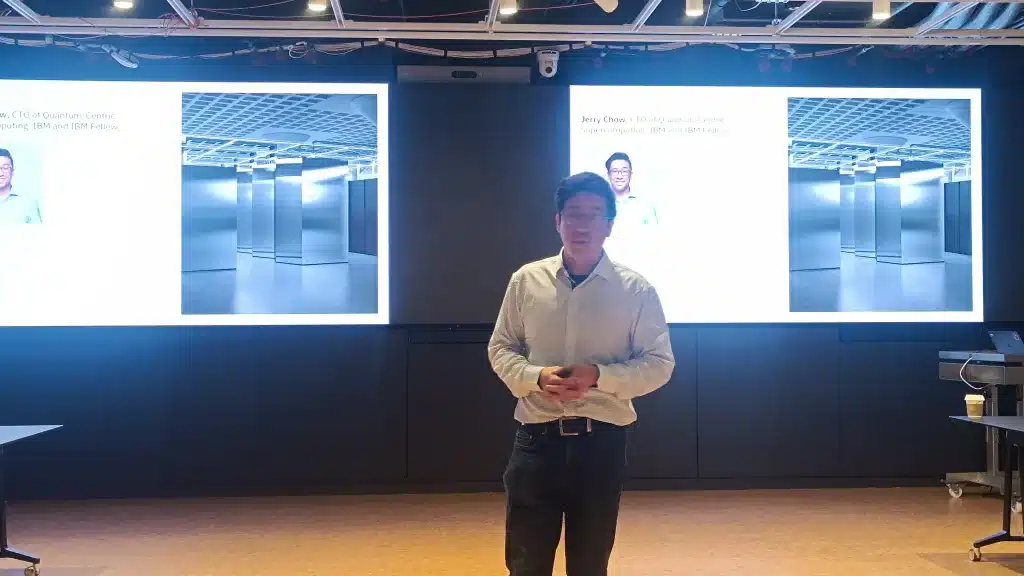
For Chow, the true differentiating capacity of quantum computing lies in the language of quantum circuits. By performing operations that take advantage of superposition and entanglement, mathematical problems can be solved that are beyond the simulation capabilities of any current classical computer.
Chow’s vision is not because quantum replaces traditional computing, but because it becomes an “equal partner” in the ecosystem alongside CPUs and GPUs. A concrete example of this vision is the work done with the Cleveland Clinic and RIKEN, where a hybrid workflow was used to simulate the energetic properties of a protein of more than 12,000 atoms, a task impossible to perform alone on a current quantum computer, but which was achieved by breaking the problem down through classical computing and running the critical parts on quantum systems.
An investment of 10,000 million
To realize this vision, IBM has announced a massive investment of more than $10 billion over the next five years. This capital will go towards research and development, manufacturing expansion, ecosystem partnerships and acquisitions. The primary goal is to accelerate the company’s roadmap to deliver the first large-scale, fault-tolerant quantum computer, called IBM Quantum Starling, by 2029.
Among the highlights of this investment are:
- IBM Quantum Starling (2029): a system capable of executing 20,000 times more operations than current systems.
- Anderon: The creation of the world’s first purely quantum wafer foundry, to which IBM will contribute $1 billion in cash along with intellectual property and assets.
- Quantum advantage: IBM is confident that its partners will demonstrate “quantum advantage” (solving problems more efficiently than with classical methods) as early as 2026.
- Leading Software: Establishing Qiskit as the preferred software stack, currently used by 70% of the world’s quantum developers.
With more than 90 quantum systems deployed globally and a network of more than 340 partner organizations, this investment seeks to ensure that quantum leadership remains anchored in innovation and cutting-edge infrastructure.
