
Artificial intelligence has ceased to be a technology associated exclusively with laboratories and large technology companies and has become a tool that is increasingly present in everyday life. Education, health, accessibility, entrepreneurship or data management are some of the areas in which its possibilities are already being explored. But along with the opportunities, new questions appear: how to use it responsibly, how to guarantee trust and, above all, how to ensure that its development translates into real benefits for people.
The Samsung Innovation Campus Summit 2026, held in Madrid under the motto AI for a Better World, revolved around these issues. The meeting brought together institutional representatives, experts and professionals to analyze how to move from the potential capabilities of artificial intelligence to concrete applications capable of generating social impact.
During the day, Elena Fernández Angulo, director of Corporate Marketing and Communication at Samsung Electronics Iberia, highlighted the company’s vision of the role that technology should play. In his speech he pointed out that innovation has to be accompanied by trust and developed on principles such as equity, transparency and responsibility.
For Fernández Angulo, one of the challenges is also to facilitate more people to acquire the necessary skills to function in this new technological reality. In this sense, he stressed the need for companies and Administrations to collaborate to develop talent and bring new capabilities to young people.
The message connects directly with the activity of Samsung Innovation Campus, a program that offers free training in artificial intelligence, IoT, Big Data and programming in collaboration with universities and educational and social entities. The initiative has accumulated more than 90 courses and more than 1,900 students trained, with the aim of improving their digital skills and employability.
Ethics, trust and critical thinking
The other big question addressed during the Summit was the relationship between artificial intelligence, ethics and governance. Idoia Salazar, founder and president of OdiseIA, focused on the need to face the changes that AI is causing from a global perspective and accompany them with supervision and education measures.
The expansion of artificial intelligence, Salazar pointed out, poses an important educational challenge. It is not only about learning to use new tools, but also about preparing society to live with them and develop critical thinking that allows us to understand their implications.
Trust thus becomes a fundamental element. The evolution of AI can lead to systems capable of taking on more and more tasks in our daily lives, but technological development must keep the human being at the center. Hence the importance of working on what Salazar defined as a “mental gym”: developing the necessary skills to use technology judiciously.
Samsung itself summarized this idea during the meeting by pointing out that the value of AI does not depend only on what it is capable of doing, but also on how it is integrated into people’s lives and the conditions of trust and responsibility that accompany its use.
From technology to social impact
The round table held during the Summit made it possible to transfer these reflections to the field of concrete applications. Fernando Trujillo, director of the UGR-Autonomous City of Ceuta Chair in Artificial Intelligence and Emerging Technologies for Well-being, participated in it; Orlando Vergara, founder and CEO of Bluebarna Ecosystems; Raquel Pelegrín, CFO of Libelium; and Jesica Rivero, project manager of the R&D&I Department of Fundación ONCE, with Federico de Juan as moderator.
One of the central themes was the ability of artificial intelligence to break barriers and improve the autonomy of people with disabilities. Among the examples analyzed are functionalities such as the generation of subtitles for people with hearing disabilities or technologies capable of recognizing the environment to facilitate interaction with it.
The ONCE Foundation precisely emphasized that disability must be considered from the first phases of technological design and in large data sets, preventing systems from reproducing situations of discrimination.
Health was another of the great areas of debate. Orlando Vergara highlighted the possibilities of AI to accelerate processes related to drug discovery, while the potential of technologies such as 5G connectivity to advance prevention and intervention was also put on the table.
Raquel Pelegrín stressed, for her part, the possibility of combining data from the physical world with intelligent technologies to optimize resources and improve mobility, while Fernando Trujillo explained some initiatives developed in the educational and social field, including applications aimed at addressing the diversity of students and projects aimed at reducing the digital divide.
The shared conclusion was that the impact of AI should not be measured solely by its technical capabilities. It is also necessary to analyze what problems it helps to solve, what autonomy it provides to people and what social and economic return it generates.
The opportunity to grow in a new digital environment
The change is also affecting the way in which companies and citizens access information. Carlos Gómez González, co-founder of AIKO, addressed during the Summit the evolution towards the so-called GEO (Generative Engine Optimization), a new scenario in which organizations must take into account how their content is interpreted and displayed by artificial intelligence systems.
His intervention, under the title “GEO, the opportunity to grow”, put on the table a territory still under construction. The positions and visibility criteria in the new generative environments are currently being defined, which opens a window of opportunity especially for small companies and entrepreneurs.
From training to real solutions
One of the most significant moments of the day came with the presentation of the II National Artificial Intelligence Awards, awards that recognize projects developed by Samsung Innovation Campus students and that seek to demonstrate that training can become applied solutions to specific problems.
The Samsung Innovation Campus Summit 2026 brought together experts to analyze how AI transforms society
In the general category, the LiveR project, developed by Joaquín Berenguer and Sergio Tordera, from the Universitat Politècnica de València, together with the La Fe Health Research Institute, was recognized for exploring the use of AI in one of the most complex processes of liver transplants: the matching between donors and recipients. The tool analyzes different variables to facilitate the identification of possible matches and support the clinical decision, without replacing the criteria or judgment of health professionals.
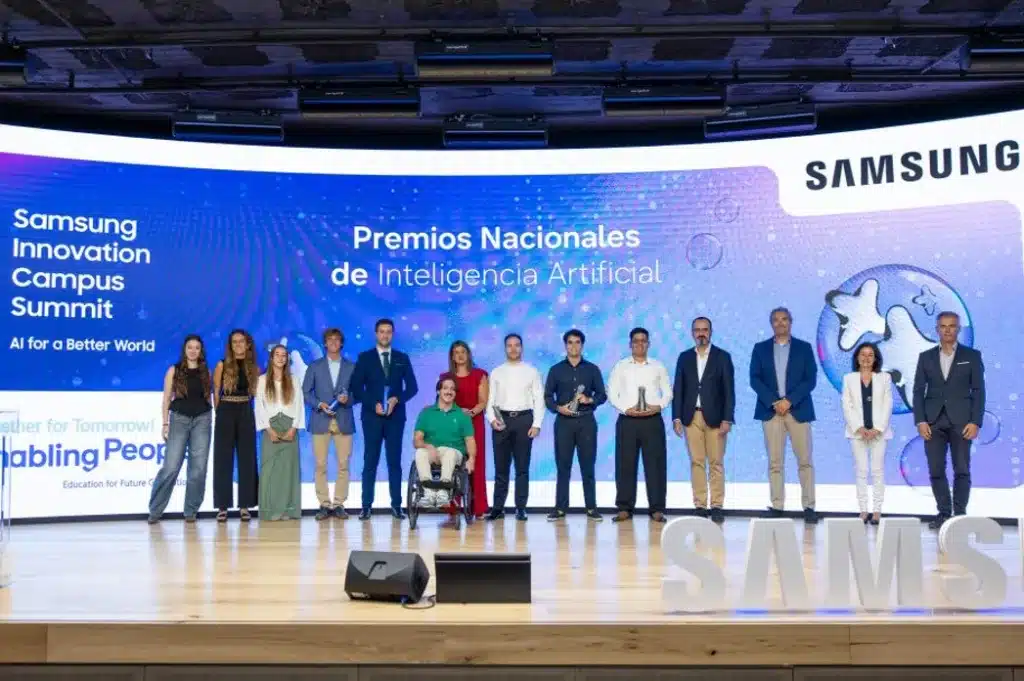
The second award-winning project was ParaTalent Hub, developed by Ignacio Jiménez, Miguel Martín Rodrigo and Juan Sebastián Flores Olivos, from the Polytechnic University of Madrid, in the category linked to the Spanish Paralympic Committee. The initiative uses AI to explore tools to support functional classification and talent detection in Paralympic sport by analyzing profiles and reference data sets.
Both projects represent, in practice, the objective that Samsung wants to promote with its training program: that learning artificial intelligence does not end in knowledge of a technology, but rather allows young people to use it to address real needs in society.
The Samsung Innovation Campus Summit 2026 concluded with the intervention of Miguel López-Valverde Argüeso, Minister of Digitalization of the Community of Madrid, after a day that left a transversal idea: the future of artificial intelligence is not only played in the power of the models or in the new functionalities, but in the ability to use them judiciously to improve people’s lives.