Artificial intelligence is taking companies to a new stage. After a first phase marked by experimentation with generative models and conversational assistants, the next step involves incorporating agents capable of interpreting objectives, making decisions within established parameters and executing actions on corporate systems. It is what Salesforce calls the agentic company, a model that constitutes the axis of its strategy and that has focused a good part of the announcements made during Dreamforce 2026, its annual meeting held once again in San Francisco.
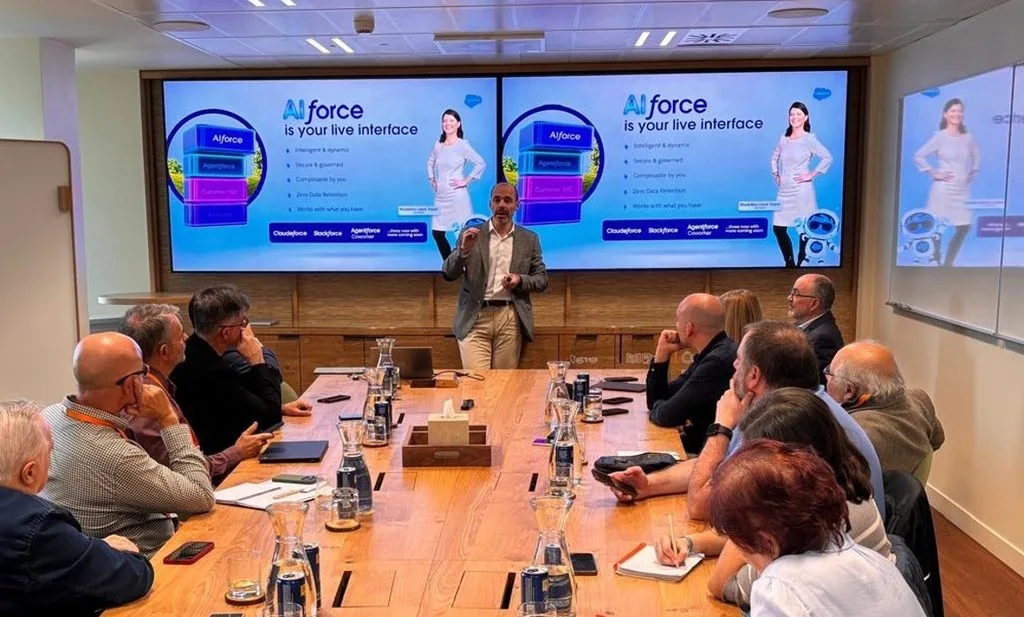
In a meeting with the press, Marco Hernansanz, EVP & CEO for Southern Europe, Middle East and Africa at Salesforce; Natalia Escobedo, country manager for Spain and Portugal; and Gonzalo Goñi, Solutions Engineering Director of Salesforce Iberia, explained how the company is evolving its platform to facilitate this transformation and allow agents to work beyond traditional applications.
One of the most relevant changes affects precisely the way of accessing business software. Applications are no longer closed environments that users must enter to perform a specific operation. Now, its functionalities can be available from other interfaces, such as Slack, Claude or different artificial intelligence platforms. “The interface becomes something that can live within Salesforce, in Slack, on third-party platforms or even in AI environments,” Hernansanz explained.
This strategy is embodied in AIforce, Salesforce’s new interface layer, which allows corporate data, applications and processes to be transferred to the work environment chosen by each organization. Among its possibilities are Claudeforce, the result of the alliance with Anthropic; Slackforce, which integrates Salesforce capabilities into Slack; and Agentforce Coworker, an assistant integrated into Salesforce that allows you to consult information and execute tasks using natural language.
The growth of this model is beginning to be reflected in the business figures. Hernansanz highlighted that Agentforce registers a growth of 240%, while the number of organizations that have already gone from testing to deploying agents in production increases. According to global data presented by Salesforce, its annual recurring revenue linked to Agentforce reached $1.5 billion in the second quarter of the fiscal year, while accounts with agents in production grew 70% compared to the previous quarter. The use of MCP servers and the headless platform also increased six-fold.
The manager stressed that EMEA is growing above the global average and highlighted the role that Spain is acquiring within the company’s strategy. In this sense, he recalled the commitment to invest $1 billion in the Spanish market over the next five years, aimed at strengthening its infrastructure, promoting agentic artificial intelligence projects and developing the talent ecosystem. “Spain has a very important role and we want it to be a reference hub,” he said.
Four layers to build the agentic company
From a technological point of view, Gonzalo Goñi explained that an organization needs four fundamental elements to evolve towards this model: data, agents capable of executing actions, language models that allow reasoning and planning, and interfaces that facilitate the interaction between people and intelligent systems.
Salesforce has structured its proposal around four layers. Data 360 provides unified access to corporate information; Customer 360 brings together applications, processes, permissions and business rules; Agentforce provides the technology to create and deploy agents; and AIforce allows you to bring its capabilities to different work environments.
The combination of these elements seeks to solve one of the main obstacles of business AI: ensuring that the models are not limited to generating responses, but can act on an organization’s systems with guarantees. To achieve this, Salesforce is committed to combining the probabilistic reasoning capacity of large language models with the deterministic logic of corporate applications, where the permissions, rules and procedures that must be respected are established.
Koa also stands out in this scenario, the reasoning model developed by Salesforce specifically for CRM operations and built on NVIDIA Nemotron. According to the company, it is trained with synthetic scenarios, without using real customer data, and seeks to improve accuracy in common business management tasks. Goñi also insisted that the strategy does not involve imposing a single model: “Salesforce’s philosophy is that customers can use the model they want.”
Interoperability is another priority. Using protocols such as MCP and A2A, organizations can connect agents developed with different technologies and allow them to collaborate with each other. Agent Fabric is located in this area, integrated into the MuleSoft proposal, which allows you to discover, connect, orchestrate, govern and supervise agents from different platforms. The goal is for a company to be able to control what its agents do, what information they access, and what resources they consume, regardless of who developed them.
From experimentation to real use cases
The strategy also contemplates facilitating adoption through agents prepared to perform specific functions, without the need for each organization to build them from scratch. Among the new features of Dreamforce are agents specialized in customer service, sales, opportunity management and internal processes, as well as Agentforce Coworker, conceived as a co-worker capable of coordinating tasks and consulting information from different sources.
“Any company with Salesforce technology can be agentic,” highlights Gonzalo Goñi, Solutions Engineering Director at Salesforce Iberia.
For Natalia Escobedo, this evolution is no longer limited to large corporations or experimental projects. “Agentic AI is already a reality in companies of any size,” he said. The board highlighted that more than 70% of IBEX 35 companies are Salesforce clients and that adoption is spreading to very different sectors.
Among the Spanish examples he mentioned CaixaBank, which is incorporating different platform solutions; the European University, which uses agents to facilitate the recruitment and attention of future students; and different initiatives in the public sphere, such as the services of the Barcelona City Council and the User Service Center of the Community of Madrid.
The company wants to accompany this evolution also through talent development. Escobedo pointed out that its activity in Spain includes programs to incorporate young professionals, such as Graduates, as well as agreements with universities and projects aimed at promoting innovation.
The challenge, therefore, is no longer just about having more powerful artificial intelligence models. The transformation requires connecting data, integrating processes, coordinating agents and establishing control mechanisms that allow these technologies to be brought into daily operations. Salesforce wants to be at the center of this change with an open platform, capable of working with different models and systems, in which people and agents increasingly share tasks and responsibilities.