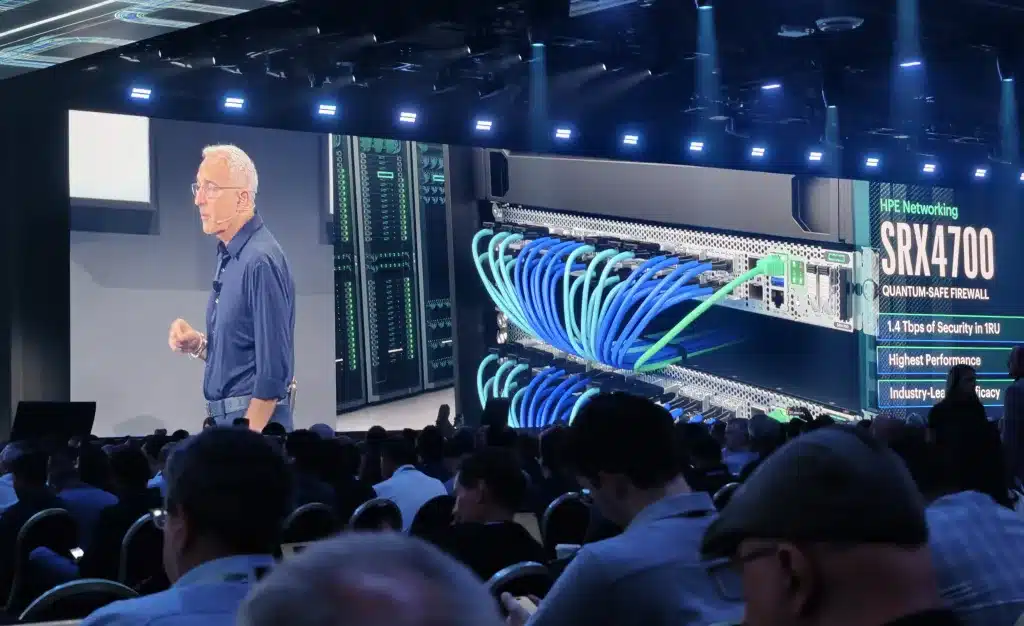
“AI is only as strong as the database on which it is built.” With this statement, Antonio Neri, president and CEO of HPE, marked the message of his keynote that took place at HPE Discover 2026, held in Las Vegas, where the company presented its advances in autonomous networks, agentic AI and quantum computing, technologies destined to transform current business infrastructure.
During his speech, the manager defended that the current technological transformation requires a new business architecture based on three fundamental pillars: networks, hybrid cloud and artificial intelligence.
“Every byte, every token and every decision goes through the network,” said Neri.
Neri defined the current moment as one of the largest technological platform changes in history. “Applications are no longer powered solely by users, but also by AI agents that will transform the way we design, build and operate our businesses,” he noted.
Under the concept “Architecting for AI”, the head of HPE presented a broad portfolio of innovations aimed at building infrastructures prepared for the era of generative AI and agentic AI, with special prominence for autonomous networks, AI factories developed together with Nvidia and advances in quantum computing.
Autonomous networks for the AI era
One of the most relevant announcements was the expansion of HPE’s autonomous networking strategy, reinforced after the integration of Juniper Networks and aimed at offering a unified experience from the edge to data centers and AI factories. “The performance of the entire architecture depends on the network. Every byte, every token and every decision goes through the network,” Neri said.
The company announced new capabilities to extend its “Self-Driving Network” strategy to its entire networking portfolio. New features include the addition of Aruba CX switches to the HPE Mist platform and the expansion of Marvis, the AI-based conversational assistant, to a greater number of network environments. The proposal allows us to move towards networks capable of self-diagnosis, automatic optimization and resolution of incidents without human intervention.
Additionally, HPE unveiled new connectivity solutions designed for large-scale artificial intelligence environments. Among them are the new QFX 5250 switches for AMD Helios architectures, interconnection equipment for large AI clusters and new platforms for distributed inference environments at the edge.
In parallel, the company reinforced its commitment to the convergence between networks and cybersecurity through a unified SASE strategy and Zero Trust architectures. According to Neri, “the network is becoming an active security layer that is capable of applying policies, detecting threats and reducing risks that can occur from the edge to the cloud.”
Quantum computing comes closer to the real world
Another of the big announcements from HPE Discover 2026 was related to quantum computing. During the keynote, Antonio Neri defended that the next technological revolution will come from the convergence between artificial intelligence, supercomputing and quantum technologies. “With initiatives like the Quantum Scaling Alliance and our work in distributed quantum simulation, we are helping to take quantum computing out of the laboratory and into the real world,” he explained.
In this area, HPE has expanded its collaboration ecosystem with eight companies specialized in quantum technologies: Intel, IQM, Qblox, Quantinuum, QuEra Computing, Quantum Machines, Rigetti and Riverlane. The objective is to develop together with HPE hybrid platforms capable of integrating HPC systems and quantum computing to solve scientific and industrial problems of extreme complexity. The objective is to accelerate the arrival of practical applications in areas such as scientific research, health, advanced industry or national security.
HPE and Nvidia advance enterprise agentic AI
Artificial intelligence occupied a good part of Antonio Neri’s presentation. The manager assured that the industry is entering a new phase in which AI agents not only generate content, but also make decisions and execute actions within business processes. “IT departments will soon be responsible for thousands of agents who will be part of organizations’ digital workforce,” he said.
To respond to this new scenario, HPE announced an important evolution of its joint strategy with Nvidia aimed at bringing agentic AI to production environments. The company introduced new governance, security and scalability capabilities for HPE Private Cloud AI, its private cloud platform for AI, designed to deploy agents close to corporate data.
“When we launched HPE Private Cloud AI two years ago we provided AI Factory out of the box. Today we are expanding it for the next generation of Agentic AI payloads,” Neri stressed.
Among the new features is a new three-level identity model that allows users to be verified, agents to be governed, and approvals to be established with human supervision for sensitive actions. Capabilities developed together with Nvidia OpenShell are also incorporated to run agents in isolated environments with integrated access and control policies.
Added to this is the integration of a governed data layer together with the Nvidia AI Data Platform, allowing agents to access structured and unstructured information of the organization more quickly and securely. “Governance is essential, but it is not enough. The intelligence of the agents will depend largely on the data with which they are trained,” highlighted the CEO of HPE.
New AI factories and more power for inference
The collaboration with Nvidia also extends to the infrastructure field. During Discover 2026, HPE introduced new capabilities for its AI factory portfolio, including support for new Nvidia Vera processors and confidential computing technologies.
Among the new features is the new HPE ProLiant Compute DL394 Gen12 server, equipped with Nvidia Vera CPUs and aimed at inference loads and agentic AI applications with high processing needs. According to Neri, these loads “demand rapid orchestration, continuous evaluation, and real-time access to data.”
Additionally, HPE expanded the scalability of Private Cloud AI to 256 GPU configurations and added new multi-node inference capabilities to run larger models. Additionally, the company is expanding support for Nvidia Confidential Computing, a technology designed to protect data, models and workloads while they are processed.
An infrastructure prepared for the future
Throughout his speech, Antonio Neri insisted that the success of AI will depend on the ability of organizations to build a solid technological base prepared to evolve.
“The decisions we make today will define the success of tomorrow,” he concluded. “Start with the network, make it the core of your cloud and AI solutions, and let HPE and its partners help you build that future with confidence.”