
Huawei has announced at MWC 2026 in Barcelona a whole new series of product innovations and enhanced AI-centric network solutions that will help operators prepare for the era of Agentic AI, enabling intelligent services, networks and network elements (NE). The common thread of the presentation was the transition towards “AI-Centric” networks and the evolution towards the “Agentic Era”, where artificial intelligence is not only added to services, but redefines the central infrastructure (networks, computing and storage).
Under the motto that appears on its stand “Advancing all intelligence”, the company presents AI as both a disruptive force and a strategic opportunity to transform core telecommunications services, modernize network operations and unlock multi-dimensional monetization. The strategy encompasses three layers of intelligence: service intelligence through multi-agent platforms; network intelligence through autonomous networks (DNA) moving towards single-domain autonomy; and network element intelligence (AI4S) and is supported by an open source computing foundation.
Large-scale 5G-A adoption
The era of agent networks is accelerating significantly, as is large-scale commercial adoption of 5G-A. It is also creating AI-centric networking solutions to enable intelligent services, networks and network elements (NEs), accelerating the large-scale deployment of autonomous layer 4 networks (AN L4). Together with other relevant players in the sector, the company is developing value-based networks and AI computing pillars for an intelligent future.
Huawei seeks to enable intelligence through three pillars: services, networks and network elements (NEs). In this sense, Richard Liu, president of ICT Marketing & Solution Sales at Huawei, presented the largest portfolio on the market, highlighting that “NE Intelligence” is supported by algorithms that optimize spectrum and energy efficiency. “Businesses that adopt ToB (Business) and ToC (Consumer) solutions with AI are growing at a rate of 15%, achieving “zero errors” in network access,” he noted.
Over the next five years, the company plans to collaborate with global operators on the large-scale deployment of 5G-A, use high-speed uplink to address the growing demand for mobile AI applications from consumers and industry, and use the U6 GHz band to make the most of the spectrum and pave the way for a smooth transition to 6G.
There are currently more than 90 million 5G-A users around the world, and operators are expected to adopt this technology on a larger scale. Huawei’s announced U6 GHz products and solutions use innovative technologies to create a high-capacity, low-latency, optimal-experience backbone network designed for mobile AI applications.
Three-layer intelligence with AI-centric network
Following the trend of integrating AI directly into networks, Huawei is using it to create AI-centric network solutions that will serve as target networks for the agency era. These solutions integrate intelligence in three layers:
At the service layer, Huawei helps operators build multi-agent collaboration platforms, with specialized agents for calling, experience monetization and home broadband. These platforms will enable AI-driven transformation of operators’ core services, such as voice, internet access and home broadband.
At the network layer, Phase 1 of Huawei’s Autonomous Driving Network L4 (AND L4) solution primarily focuses on automating single scenarios, helping operators dramatically improve operations and maintenance (O&M) efficiency, network quality, and monetization capabilities.
By the end of 2025, the company’s single-scenario DNA solutions will have been commercially deployed in more than 130 telecommunications networks worldwide. Going forward, Huawei will continue to help operators restructure their operations with AI, going beyond single-scenario automation to drive end-to-end single-domain network autonomy.
At the NE layer, Huawei collaborates with operators to drive innovation in areas such as algorithm optimization for RAN, intelligent and accurate service identification for WAN, and unified service intent for core networks that facilitates the integration of B2C and B2H services.
Innovations in these areas are already driving significant improvements in grid energy and spectral efficiency, intelligent service awareness, and ensuring grid resilience.
Computational backbone with SuperPoDs and clusters
In the computing field, Huawei presents for the first time outside China its computing cluster and its SuperPoD products, which incorporate innovations in system-level architecture, including its UnifiedBus technology for the interconnection of SuperPoD.
Huawei has updates to its SHAPE 2.0 partner platform, with 22 new industrial intelligence solutions
Key products include the Atlas 950 SuperPoD for AI computing, the TaiShan 950 SuperPoD for general-purpose computing, the Atlas 850E SuperPoD, and the TaiShan 500 and TaiShan 200 servers. These offerings are Huawei’s response to the demand for more powerful computing and lower latency, two elements especially crucial as trillion-parameter AI models become mainstream and agent AI is introduced into core production systems.
The vision of Seaway Zhang, president of Huawei’s Computing Product Line, focuses on the resilience and rapid evolution of Agentic AI, moving from perceiving AI to mass adoption. Among the star launches, the Atlas 950 SuperPoD stands out for being a massive computing base for large-scale training and inference, and the TaiShan 950 SuperPoD, a system optimized for databases and virtualization, unlocking critical performance peaks for operators. It also highlights Huawei’s strong commitment to Open Source to bring AI innovation to operators under the construction of an open computing ecosystem.
Up to 22 new industrial intelligence solutions
Huawei has also presented 115 industrial intelligence solutions together with its customers at the Digital and Intelligent Industrial Transformation Summit 2026. The summit, titled “Advancing Comprehensive Industrial Intelligence”, was organized by Huawei to explore new practices in industrial intelligence with its customers, partners and colleagues.
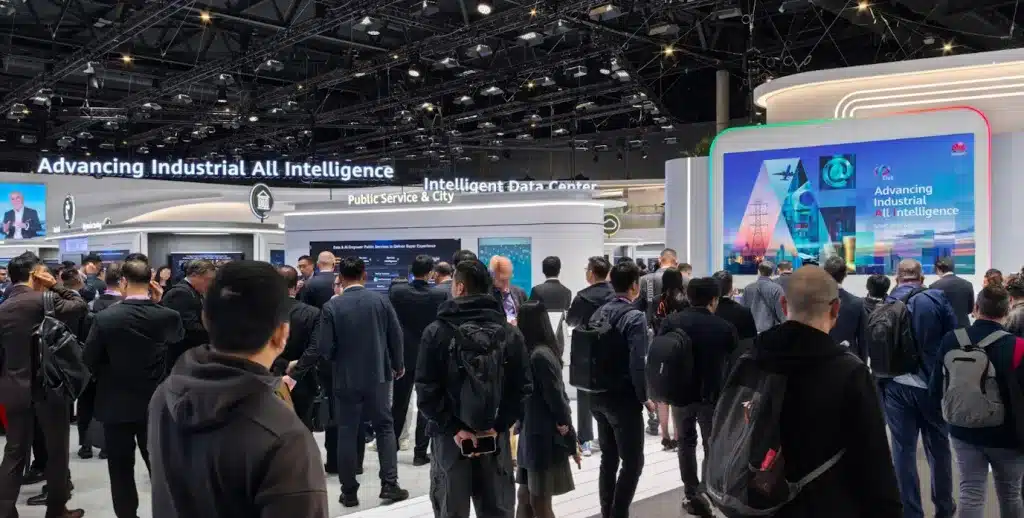
In addition, Huawei has updates to its SHAPE 2.0 partner platform, with 22 new industrial intelligence solutions that have been developed together with its partners for strategic sectors such as: electric power, manufacturing and retail, finance, transportation, oil and gas, internet service providers (ISP), media, public services and smart cities.
In the storage section, Yuan Yuan, president of Huawei’s Data Storage Product Line, announced a milestone in data management for the era of artificial intelligence, with the arrival of Huawei AI Data Platform, which includes the industry’s first “3-in-1” platform (Huawei UCM), designed specifically to support the high data processing demands required by today’s AI.