This morning a new information meeting organized by Nueva Economía Fórum (NEF) took place together with the CEU in Madrid, where the president of Microsoft Spain, Paco Salcedo, participated. The event began with a minute of silence in memory of the victims and all those affected by the train accident that recently occurred in the town of Urda.
The president of Microsoft Spain defends that AI must reach all organizations and sectors, from large companies to SMEs and public administrations, to boost competitiveness, productivity and the transformation of the economy. During his speech, open to questions from attendees, he highlighted that artificial intelligence has ceased to be a technology reserved for innovation departments and has become a strategic opportunity that affects the entire economy. “Companies, public administrations and organizations of all sizes face the challenge of incorporating their capabilities into business processes, improving productivity and developing new activity models. A scenario in which Spain starts from a favorable position,” he stressed.
During his speech, Salcedo highlighted that our country is in a position to take advantage of this technological transformation at the same level as the main world economies. “Spain is in pole position, because we don’t have to wait years for the technology to arrive. We are at the same level as the leading countries,” he stated. In his opinion, this circumstance represents an opportunity to change the way of working, increase productivity and ensure that Spanish companies become leaders within their respective industries.
From SMEs to administrations: Microsoft is committed to extending AI to the entire economy
The manager also focused on the need to extend this transformation beyond large corporations. In a business fabric like the Spanish one, made up mostly of small and medium-sized companies, preventing the adoption of AI from generating new inequalities is a priority. Salcedo recognized that there is a gap between large companies and SMEs, whose main barriers are related to the knowledge and support necessary to incorporate these solutions. For this reason, he called for the involvement of technology companies and public administrations to facilitate access to these tools and guarantee that organizations of all sizes can benefit from them. Microsoft currently has around 12,000 partners in Spain who are the ones who execute the solutions and bring them closer to customers. Salcedo recalled that there are startups with intellectual property on these AI platforms and that “as a result of creativity it is possible to generate new employment opportunities,” he noted.
Streamline administrative processes with greater transparency
The opportunity also reaches the public sector. For Salcedo, artificial intelligence can contribute to improving the services that citizens receive, streamlining administrative processes and making public organizations more efficient. “It is a great opportunity for public services because technology is now much more transparent than before,” he noted, highlighting the potential of these tools to overcome some of the bottlenecks that have traditionally limited the transformation of certain processes.
From experiment to results
One of the main challenges organizations face is getting artificial intelligence beyond pilot projects. Although many companies are already experimenting with these solutions, they are not always able to translate their benefits into tangible results. For the president of Microsoft Spain, the key is to approach its implementation with specific objectives and a strategy that allows it to be deployed at scale.
“We must be clear about the objectives, what we are trying to solve. We must identify where the bottlenecks are to facilitate results,” he explained. It is not, therefore, about incorporating AI just for the sake of it, but about identifying those processes in which it can provide differential value and mobilizing the necessary resources to achieve it.
This transformation also requires establishing governance mechanisms. The fact that AI can empower all employees in an organization requires defining rules, controls and criteria for responsible use. In this sense, Salcedo defended the importance of resorting to corporate solutions capable of providing models with the context and data necessary to respond to the needs of each company. An approach that allows information to be protected, preserve the sovereignty of organizations and develop specialized models in areas such as healthcare, telecommunications or banking.
“It is the true sovereignty of organizations, understanding the context of an organization and everything we create above AI, which will differentiate companies,” he noted. In his opinion, a good part of the value that companies can extract from this technology lies not so much in having a generalist model, but in adapting it to their knowledge, processes and specific needs.
Infrastructure, talent and security
The expansion of artificial intelligence also requires computing capacity and infrastructure that can respond to the increase in demand. In this area, Salcedo recalled Microsoft’s investment commitment, which has allocated more than 120 billion dollars to its technological assets and which considers Madrid and Aragon to be two strategic enclaves. Having these infrastructures in Spain represents, as explained, a competitive advantage to facilitate access to technology, improve service levels and expand the range of available solutions.
However, he recognized that the current capacity is still insufficient and that it will be necessary to continue expanding it. An expansion that, as he stressed, must be carried out with sustainability criteria and without transferring negative effects to the communities where the data centers are deployed. “We are committed to paying whatever is necessary so that it does not have a negative impact on the communities where it is deployed,” he assured, also referring to the energy impact of these facilities.
Mixed teams of people and agents
The transformation will also have consequences on the labor market. Salcedo acknowledged that some positions and activities will be affected, although he believes that the economic acceleration that AI will bring will also generate new professional needs and opportunities. From their perspective, the greatest risk for workers lies not so much in the technology as in not learning to use it. “The biggest risk we have as workers is not learning this new technology,” he warned, while claiming intrinsically human capabilities such as creativity and the ability to reinvent the way of working.
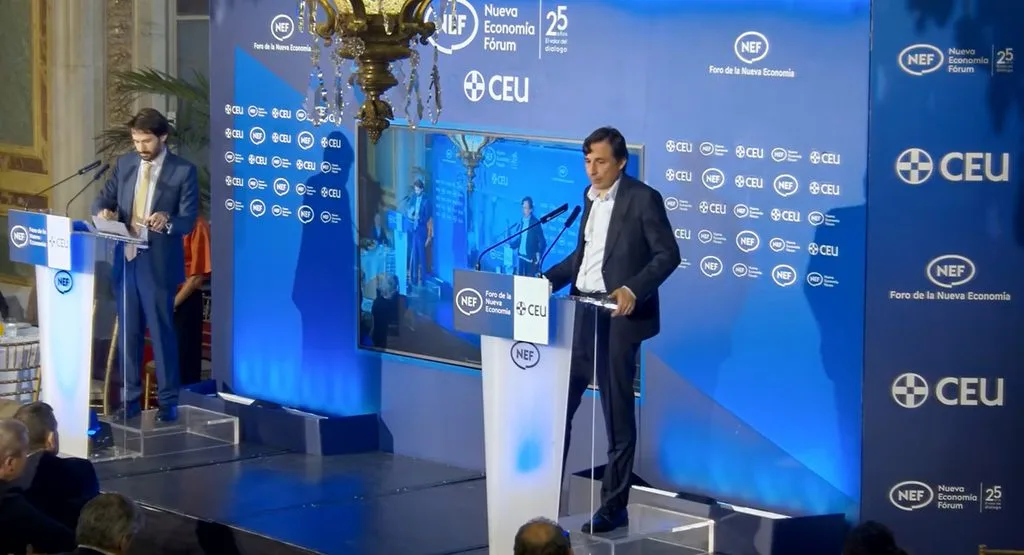
Cybersecurity was another of the topics addressed. For the head of Microsoft Spain, “security can no longer be guaranteed without the use of AI.” However, this incorporation also requires strengthening the protection of the intelligent systems themselves, controlling the identity of the agents and establishing trust mechanisms that allow their actions to be monitored.
“The biggest risk for workers is not learning to use AI,” highlights Paco Salcedo.
Precisely, the development of artificial intelligence agents anticipates a new work model in which people and autonomous systems will share tasks and responsibilities. Salcedo believes that organizations will have to get used to working with mixed teams, made up of employees and agents, but always under observable processes, continuous evaluations and control mechanisms.
This evolution also poses cost challenges. Although the price of using the models will tend to be reduced thanks to more affordable solutions and open models, organizations will have to learn to control consumption and allocate resources efficiently. The manager considers that each department will have to manage its own AI costs, in a similar way to what already happens with other technological items.
In short, artificial intelligence represents an opportunity that, in Salcedo’s words, is in the hands of organizations and society. To take advantage of it it will be necessary to experiment, learn and establish appropriate guarantees. “What we do with this technology will mark the future of society,” he concluded.