
Confluent has just held its Current 2026 conference in San Francisco (USA) where the company recently acquired by IBM has provided the key capabilities of the Streamhouse architecture, designed to provide continuously updated business context to artificial intelligence agents and critical applications. With the general availability of Lightning Tables, the company completes its unified five-pillar platform: Transmit, Connect, Process, Govern, and Query.
During the event, it became clear that the digitalization of companies has reached a turning point where the volume of information processed is no longer the only factor that influences the success or failure of an organization, but rather the immediacy and coherence with which this data is made available for autonomous decision-making.
As described, the current technological scenario is being characterized by the accelerated adoption of agentic systems that have exposed the structural limitations of traditional data storage and integration models. In this scenario, data lakes, data warehouses (warehouses) and lakehouseshistorically designed for batch reporting (batch) and retrospective analysis, are no longer capable of responding to the demands of digital agents that require interpreting the state of the business down to the millisecond. And it is this problem that Confluent wants to provide a solution to with its Streamhouse architecture, a proposal that seeks to resolve the gap between the creation of data and its operational consumption in real time.
The end of batch latency
According to the presentation made by Shaun Clowes, General Manager, Confluent and Data at Confluent, “the root of the architectural problem in large companies is found in the fragmentation of information through heterogeneous systems that update their states at different times. At that moment, when an artificial intelligence agent tries to execute a complex task, the discrepancy between contradictory visions of the same business causes execution failures, erroneous decisions or the propagation of operational inconsistencies.”
To overcome this latency trap, the Streamhouse architecture is based on three essential guiding principles: it must be continually current, mission-critical and decentralized. Unlike mass consolidation initiatives of the past, it does not require first moving all data to a centralized repository, but instead functions as an active real-time operational layer that transparently coexists with warehouses and lakehouses existing.
During the press conference after the event, attended by Byte TI, Clowes underlined the urgency of this paradigm shift when analyzing the evolution of business software. The manager highlighted how intelligent agents are drastically altering data infrastructure requirements, stating that “the next era of enterprise AI will be won by agents who know what is happening in the business at the moment they act.”
To explain the relationship between continuous information and agentic algorithms, Clowes turned to an analogy about the refining of primary resources: “If people say that data is the new oil, what they really mean is that it still needs to be refined to be useful. You can’t just burn crude oil and get something useful out of it.” In his opinion, the streaming infrastructure is that refinery that converts crude oil into gasoline, that is, into the true competitive advantage.
In this framework, AI agents are not simply advanced queries, but high-performance engines. The main problem so far is the bottlenecks that occur precisely due to human intervention. Clowes was categorical when describing the inefficiency of legacy manual processes in the face of real-time automation: “In many cases, human intervention is useless supervision. It is a speed limiter that slows everything down, so by providing companies with a continuous infrastructure, operational problems can be detected and resolved autonomously, freeing up human talent for strategic innovation tasks.”
The five-pillar platform and the innovation of Lightning Tables
The technological pillar that makes the Streamhouse architecture possible is the data streaming platform, Data Streaming Platform or DSP, developed on Apache Kafka and the Kora engine. The solution has evolved to integrate five unified core capabilities: Transmit (stream), Connect (Connect), Process (process), Rule (Government) and the newly added Query capability (query).
The streaming component captures and distributes business events with sub-millisecond latencies in internal testing. The connection pillar facilitates ingestion and output through more than 150 fully managed connectors to source and destination systems. For its part, the processing layer uses Apache Flink to enrich, transform and combine continuous streams close to the source, while the governance pillar ensures the quality, lineage, encryption and regulatory compliance of the data throughout its entire lifecycle through Stream Catalog.
The big news announced at Current 2026 is the fifth pillar, Consult (query), designed to put streaming data at the immediate service of applications, analytics and AI models. This capability is deployed through three specialized interfaces: Confluent Tableflow, which feeds lakehouses in open table formats; the Real-Time Context Engine, which connects to agents using the Model Context Protocol (MCP); and Lightning Tables.
Lightning Tables is presented as a fully managed read-only service layer that durably materializes Kafka events into queryable tables using SQL and direct APIs. Confluent’s internal testing reports an update time of approximately 100 milliseconds from data creation, with query latencies between 10 and 100 milliseconds and performance of over 1,000 queries per second. This simplifies IT architecture by eliminating the need to build complex ETL pipelines, intermediate databases, or dedicated cache layers. Additionally, it acts as a real-time feature store for personalization and machine learning.
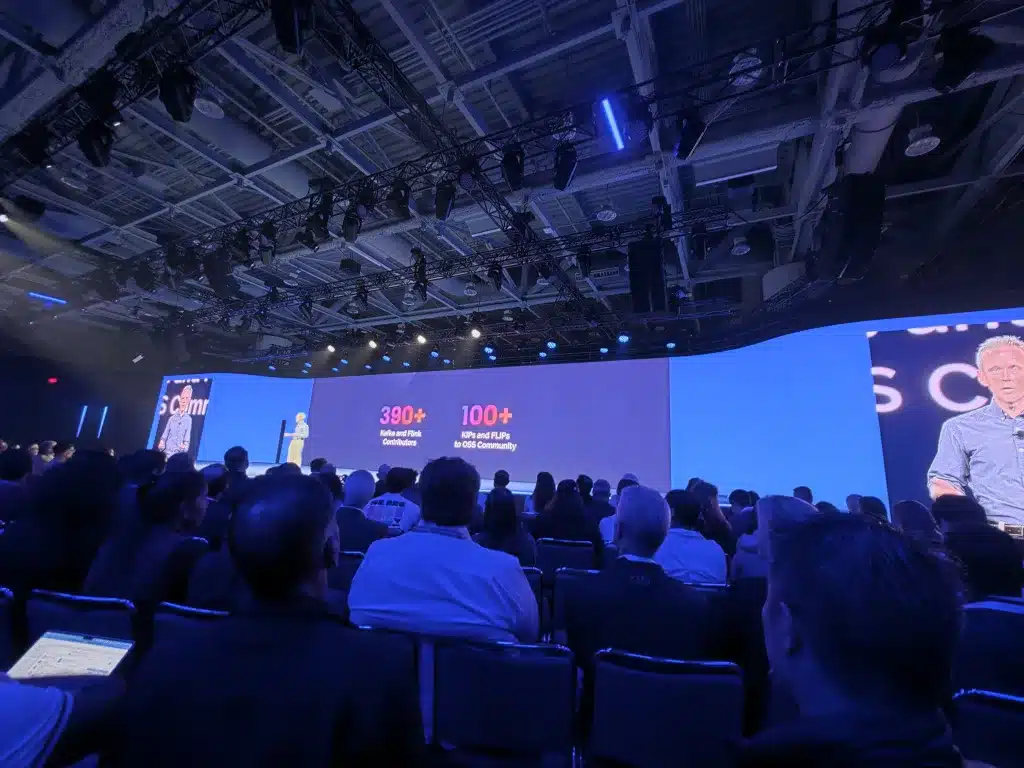
During his keynote presentation at the event, Shaun Clowes emphasized that Streamhouse is not a closed product or an isolated invention, but rather an emerging architectural pattern throughout the industry:
The availability of Lightning Tables marks a change in which the analytical query and the operational event definitively converge. As Clowes summarized during the presentation, “with Lightning Tables, our Data Streaming Platform gives every agent and application a live, governed view of the business. This means companies can act on fraud signals faster, serve customers in the moment, and execute operations based on what is true today versus what was true yesterday.”
Integration into IBM
The presentation of Streamhouse takes on an even more relevant corporate dimension following the integration of Confluent into IBM’s global structure. In the multinational’s strategic scheme, Confluent has positioned itself at the nerve center of IBM’s data strategy, combining real-time transmission with IBM’s integration, governance and AI suite. This synergy does not respond to artificial commercial packaging, but to the natural complementarity between technologies such as Apache Kafka, Apache Flink, Red Hat, HashiCorp and watsonx.
Faced with doubts from the industry about whether belonging to a technology giant could restrict interoperability with other providers, Shaun Clowes was emphatic in ratifying the open and non-restrictive vocation of the platform. Clowes conceptualized Confluent’s role within business ecosystems as an opposition to data locking (vendor lock-in). “We have what we call ‘data antigravity’. We are the opposite of a place where you put your data and it never leaves. Our job is to deliver the data to the place where it can be. We literally distribute data; we are an information exchanger in a sense.”
This vision of seamless sharing reinforces Confluent’s position by acting as a data highway that eliminates wasteful duplication and fragmented integration. Clowes detailed how this architecture lightens the load on corporate infrastructure stating that “Confluent is at the center of IBM’s data strategy. Confluent’s mission has always been to enable people to get value from their data without having to reprocess it over and over again. We act as an information superhighway between all of these different systems, eliminating the need for duplication, manual application integration, and silos.”
Likewise, the commitment to open source development continues to be a non-negotiable pillar. Confluent and IBM remain major contributors to iconic community projects such as Apache Kafka and Apache Flink. Clowes emphasized that “open source is not the enemy; it helps mobilize data, and the only way to address a problem on a global scale is to have highly successful open source projects that are used throughout the ecosystem.”