
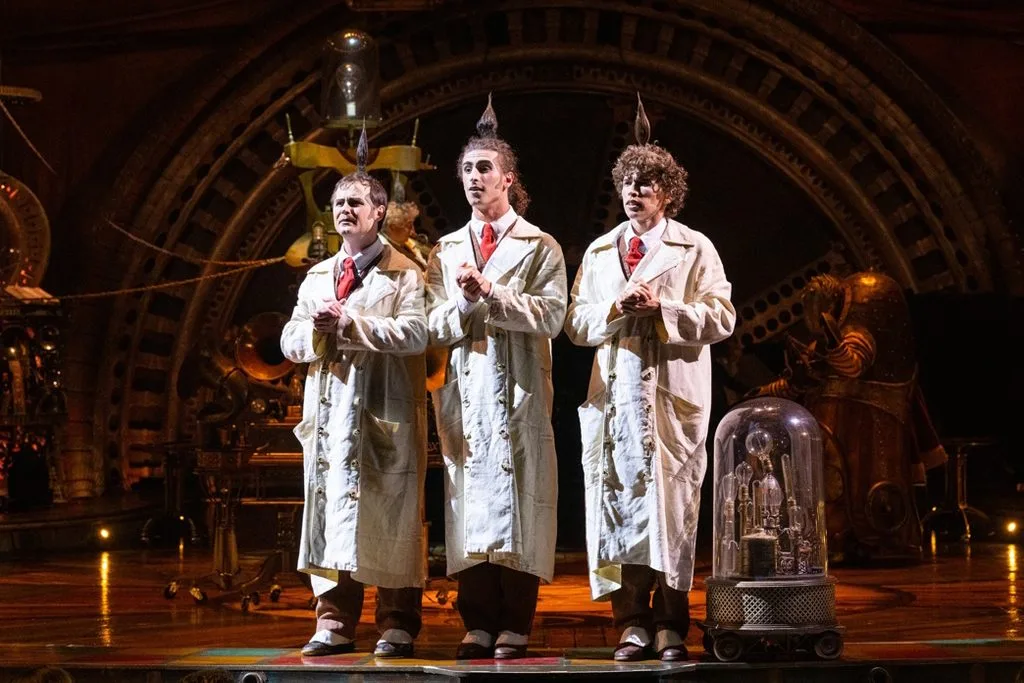
When the curtain rises on a Cirque du Soleil show, the audience witnesses a combination of creativity, acrobatics, music, scenery and technology that seeks to awaken emotions. However, behind each performance there is a huge business machine that must function with the same precision as the artists on stage. Coordinating thousands of professionals, organizing international trips, managing dressing rooms, controlling suppliers and maintaining 38 shows in different cities around the world requires a management infrastructure that goes far beyond artistic activity.
Founded in 1984 by a group of 20 street performers in Canada, Cirque du Soleil has become one of the main world leaders in live entertainment. Its career has led it to perform in nearly 1,450 cities in 90 countries and attract more than 365 million spectators throughout its history. Currently, the organization has nearly 4,000 employees, including 1,300 artists, and maintains 38 different shows on the billboard, with around 9.5 million tickets sold each year.
A large business
The dimensions of the business allow us to understand the complexity of its operation. More than 100 professional profiles coexist in the organization, representatives of more than 50 nationalities and who speak around 25 languages. Added to this is the need to manage thousands of trips, coordinate technical and artistic teams and have all the necessary materials so that each production can be carried out anywhere in the world.
As Jorge Pérez, director of Artificial Intelligence, Data & Technology Platform for Southern Europe at SAP, explains, the evolution of Cirque du Soleil is an example of how an organization can grow while maintaining its creative capacity when it has a technological structure capable of accompanying that development. The company went from being a small group of street artists to an international organization with thousands of professionals and an operation that requires coordinating numerous activities simultaneously.
More than two decades of technological collaboration
In this journey, SAP has played a fundamental role. The relationship between both organizations began in 2001 and has evolved from a client-supplier relationship to become a strategic collaboration of more than two decades. SAP business management solutions have been progressively incorporated into different areas of Cirque du Soleil, providing a global vision of its operations and facilitating the integration of processes that previously operated more independently.
For João Carvalho, director of SAP Finance and Spend Management for Southern Europe, it is not a conventional sponsorship, but a relationship in which technology has become part of the company’s operational structure. Purchasing management, expense control, relationships with suppliers, travel and human resources are some of the areas in which this collaboration has allowed us to gain efficiency and visibility.
An example of this complexity is found in the purchasing area. Cirque du Soleil works with around 16,000 active suppliers around the world and needs to acquire everything from technical equipment to the materials necessary to make its more than 18,000 costumes. With SAP Ariba, the company has centralized information, simplified procurement processes and improved expense control. Some purchasing operations are now carried out up to five times faster than with previous systems, seeking an immediate response.
Mobility is another of its great challenges. Artists, technicians and support staff are constantly moving to ensure the operation of the productions. The organization registers an average of 7,000 trips annually and carries out its activity in more than 50 countries. To manage this activity, SAP Concur allows you to standardize travel and expense procedures, improve travel traceability and have a more precise view of the associated costs.
Added to these solutions is SAP SuccessFactors, which facilitates the management of a particularly diverse workforce, made up of internal employees, artists and external collaborators. The automation of administrative processes and the centralization of information make it possible to respond to the particularities of an organization in which teams and professionals change according to the needs of each show.
From integrated management to artificial intelligence
All this evolution has been generating an important heritage of information. Carvalho precisely highlights the value of the data accumulated during years of technological transformation. The company now has a structured foundation that allows it to accelerate processes, improve decision-making and take advantage of new digital capabilities. In his opinion, the investments made previously constitute a competitive advantage today, because they provide the necessary context to incorporate more advanced technologies.
The modernization of the infrastructure, supported by RISE with SAP and the transition to SAP Cloud ERP, together with SAP Business Technology Platform (SAP BTP), has made it possible to integrate information, standardize procedures and develop applications adapted to the needs of the business. This architecture also facilitates automation and prepares the ground for incorporating artificial intelligence into different processes.
One of the most recent examples is the Invoice Assistant based on SAP Business AI, developed to improve the management of supplier inquiries. Cirque du Soleil receives more than 70,000 invoices a year and approximately 40% of the inquiries that come to its accounts payable department are related to requests for information about their status.
The company has a structured base that allows it to accelerate processes, improve decision-making and take advantage of new digital capabilities
Until now, investigating each incident could require consulting different platforms and spending considerable time locating the information. The new assistant, developed on SAP BTP and supported by SAP AI Core and SAP HANA Cloud, automatically analyzes emails, identifies requests, checks the status of invoices and prepares responses in English or French. You can also extract information from attached documents and classify queries according to their urgency.
The result is especially significant: the average work time necessary to answer each query has gone from about 30 minutes to approximately two. In addition to reducing manual tasks, the solution streamlines communication with suppliers and allows the team to spend more time on higher-value activities.
For Jorge Pérez, this advance is a consequence of a strategy that has been based on structured technology and the digitalization of processes for years. Artificial intelligence and agents now represent a new step, allowing this accumulated information to become an active tool to automate tasks and improve management. An evolution that, as he points out, fits with the particularity of a business that must transmit lightness and naturalness to the public, although behind each show there is enormous organizational complexity.
Cirque du Soleil thus demonstrates that artistic innovation and technological transformation go hand in hand. Systems integration, advanced data management and automation provide a foundation to continue growing and adapting to new scenarios. Because, although the objective is still to surprise the viewer, ensuring that each performance is carried out with precision requires that everything that happens behind the scenes works as a true management spectacle.