
The Ookla company has carried out its traditional study on the situation of the mobile telephony markets in Europe, in which it analyzes the traffic congestion presented by the 30 markets that are part of it and the behavior of the mobile networks in each of them.
The usual way of assessing the quality of mobile networks in Europe is still largely based on aggregate metrics. National average speeds, coverage percentages, and 5G adoption rates are useful, but they simplify the hour-by-hour load profile that determines how mobile networks behave when demand is highest.
In the 30 markets analyzed, the most consistent decline in mobile network download performance is observed between 7:00 p.m. and 9:00 p.m. local time. Ookla uses this interval as the afternoon peak and compares it to the period between 02:00 and 05:00 local time, when demand is lower on mobile networks. The difference between these intervals reflects a practical form of congestion: the loss of performance when the shared radio, backhaul, and core resources of mobile networks are under pressure.
This analysis is based on Speedtest samples collected by users in the 27 EU member states, plus Norway, Switzerland and the United Kingdom, during the first quarter of 2026, allowing us to observe the real behavior of mobile networks. Trends and seasonality span from January 2024 to March 2026.
Key takeaways from the study
- Spain is the most congested mobile market in Europe during evening peak hours, reflecting high pressure on its mobile networks, with a baseline value of 62. The average download speed fell from 161.20 Mbps off-peak to 54.10 Mbps during peak hours in the first quarter of 2026, a drop of 66%, while loading latency increased by 60% to 724 ms on mobile networks.
- Six markets maintained virtually flat daily performance on their mobile networks. Luxembourg (~0), Belgium (2), Norway (8), Slovakia (8), France (11) and the Netherlands (12) are at the resilience level, each with different structural characteristics in terms of data usage intensity, population mobility and density of mobile networks that help mitigate congestion.
- Switzerland is the clearest example of why general metrics alone are insufficient to evaluate mobile networks. Despite having the highest mobile ARPU in Europe, at €50.90 ($59.58) per subscriber and a 5G connection share of 74%, it has the third highest congestion value in the analysis, at 47. Its average speed drop is moderate, but load latency on its mobile networks increases by 46% and the lowest performing 10% of users experience a download speed drop of 81%, 25.50Mbps to 4.80Mbps.
- The intensity of investment and management of mobile networks explains more than wealth, spectrum ownership or market concentration. Capital expenditure as a percentage of revenue shows the strongest relationship with resilience to congestion in mobile networks among the structural variables analyzed, although it is a moderate relationship and not a deterministic rule. Differences between operators reinforce this idea: in Poland, the evening peak difference between T-Mobile and Plus is 4.1x, compared to 2.2x off-peak, meaning that peak load on mobile networks can amplify, rather than simply reflect, baseline differences.
- 5G technology improves the experience under load on mobile networks, but does not eliminate congestion. In 10 European markets with high 5G coverage, the average speed drop at peak traffic times is 32% for 4G and 27% for 5G. The most consistent advantage of 5G on mobile networks lies in latency: latency under load on 5G at peak traffic times is between 12% and 44% lower than on 4G in all markets analyzed.
- Seasonality substantially modifies the landscape of congestion in mobile networks. Spain and Croatia show recurring pressure during the summer linked to tourism; Nordic markets show a summer shift towards rural and holiday areas; while in Switzerland and Austria mobile network congestion decreases in summer, suggesting that the concentration of winter demand in ski resorts is the most pronounced stress pattern.
When concurrent demand exceeds the capacity of the available spectrum, radio configuration, and transport layer of mobile networks, per-user throughput decreases, latency increases due to queuing in mobile network buffers, and the experience of all users in that sector simultaneously deteriorates. Therefore, congestion is not only a problem of speed, but also of latency, consistency and affects the user with the worst performance within mobile networks.
BEREC’s 2024 report on the implementation of geographic studies of network deployment also illustrates the difficulty. Expected speed at peak times is considered one of the most difficult indicators for regulators to collect and standardize, and information on the quality of service on mobile networks remains uneven across markets. The European Commission’s proposed Digital Networks Law may help simplify investment conditions, but it does not eliminate the need for better data on the performance of mobile networks during peak demand hours.
Figures and results of connections in Spain
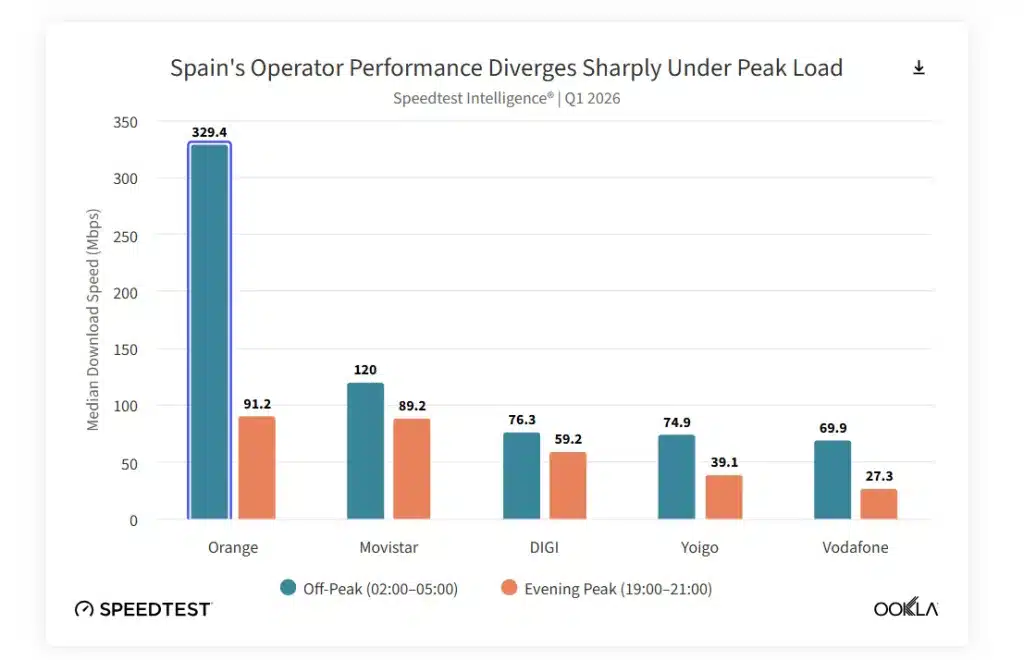
Spain shows a pattern of high potential and high decline in its mobile networks. Orange, which operates as part of MasOrange following the merger with MasMovil in 2024, offers 329.40 Mbps during off-peak hours, one of the fastest speeds recorded by any operator in any market analyzed within mobile networks. In the afternoon peak hours, this speed drops 72% to 91.20 Mbps, with a 91% drop at the 10th percentile.
This analysis is based on Speedtest samples collected by users in all 27 EU member states.
The raw capacity of mobile networks exists, without a doubt. The challenge appears to lie in distributing that capacity under concentrated afternoon demand, a pattern consistent with the complexity of network integration and traffic migration after the merger.
Movistar starts from a more moderate level in off-peak hours of 120.00 Mbps, but only drops 26% and maintains 89.20 Mbps in peak hours within its mobile networks. Vodafone Spain shows the lowest absolute maximum throughput with 27.30 Mbps, and a loaded latency of 1189 ms on its mobile networks. The full Ookla study can be accessed for additional information.
